


§ 316.2955(2)
A ±3% tolerance
Every percentage in the tint statutes carries a three point tolerance in either direction. It is a buffer for meter variance, not permission to aim under the limit. Build to the number, not to the tolerance.
At Mission Tint, we provide expert automotive care and protection services in Bonita Springs, FL. From window tinting and paint protection film, to ceramic coatings. We help preserve your vehicle’s appearance and value. Our skilled team specializes in premium services like clear bra installation and luxury car detailing, ensuring tailored solutions for every vehicle. Trust Mission Tint for exceptional results and a pristine finish every time.
- Automotive Window Tinting
- Architectural Window Tinting (Flat Glass) - Commercial and Residential
- Paint Protection Film (PPF/Clear Bra)
- Ceramic Coating & Paint Correction
At Mission Tint, we provide expert automotive care and protection services in Bonita Springs, FL. From window tinting and paint protection film, to ceramic coatings. We help preserve your vehicle’s appearance and value. Our skilled team specializes in premium services like clear bra installation and luxury car detailing, ensuring tailored solutions for every vehicle. Trust Mission Tint for exceptional results and a pristine finish every time.
- Automotive Window Tinting
- Architectural Window Tinting (Flat Glass) - Commercial and Residential
- Paint Protection Film (PPF/Clear Bra)
- Ceramic Coating & Paint Correction
Florida Statutes 316.2951 – 316.2957
Florida does not regulate how dark your film looks in the box. It regulates how much light gets through the film and your factory glass together, measured on the car. Here is exactly where the lines sit, what the statute actually says, and where most shops get it wrong.
Interactive
Drag the slider to the VLT you are considering. The sample card darkens behind the glass the same way it does on the counter in our shop, and every window is checked against the statute for your vehicle class. VLT is visible light transmission — the lower the number, the darker the glass.
Guidance only, not a legal opinion. Enforcement is based on a calibrated meter reading of film plus factory glass, with a statutory tolerance of ±3%.
Price my tintThe limits
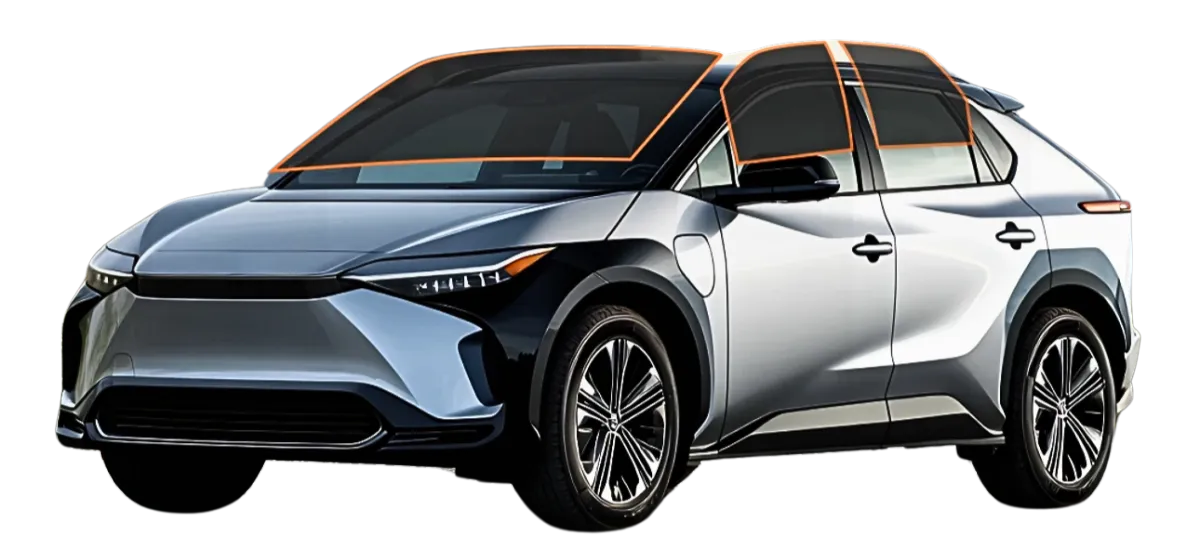
Florida splits vehicles into two classes and applies different rules behind the driver. Front side windows are identical for both. Every figure below is the minimum light that must pass through, or the maximum light that may bounce back.
| Window | Sedan & coupe | SUV, van & truck | Max reflectance |
|---|---|---|---|
| Windshield | Transparent strip along the top only, and it may not reach into the driver's forward view below the AS-1 line. No film on the rest of the glass. § 316.2952(2)(b) | Non‑reflective | |
| Front side windows | 28% VLT minimum | 28% VLT minimum | 25%§ 316.2953 |
| Rear side windows | 15% VLT minimum | 6% VLT minimum | 35%§ 316.2954(1)(a) |
| Rear windshield | 15% VLT minimum | 6% VLT minimum | 35%§ 316.2954(1)(a) |
| Perforated film | 30% VLT minimum, tested with the glass it sits on | 35%§ 316.2954(1)(b) | |
This is why a "35% film" can fail on the front doors. Most factory glass sits somewhere around 70–80% VLT before anything is applied, and the two multiply. It is an estimate — the only number that counts is the one a meter reads on your car.
Fine print
The VLT numbers are the easy part. These are the provisions that decide whether an installation actually holds up at a traffic stop.
§ 316.2955(2)
Every percentage in the tint statutes carries a three point tolerance in either direction. It is a buffer for meter variance, not permission to aim under the limit. Build to the number, not to the tolerance.
§ 316.2954(2)
If your rear window is treated so it is no longer transparent, the vehicle must carry side mirrors on both sides. Almost every modern car already does, but it is a separate requirement from the VLT limit.
§ 316.2955(1)
The installer must fix a non-removable compliance label to the inside left door jamb, showing the trade name of the film and the installer's business name. Factory glazing is exempt. If your last shop skipped it, they skipped the law.
§ 316.2951(2)
A multipurpose passenger vehicle carries ten people or fewer and is built on a truck chassis or with special features for occasional off-road use. That is a build classification, not a body shape, so some car-based crossovers fall on the sedan side at 15%.
§ 316.2956
Driving on illegal film is a noncriminal traffic infraction, charged as a nonmoving violation. Selling or installing it is a second degree misdemeanor for the shop. The installer carries more legal exposure than the driver does.
§ 316.2956(2)
Replacing or repairing material that was legally installed in the first place is not a fresh violation. Redoing a legal window with legal film keeps you where you started.
Correcting a common claim
You will see "the windshield strip must be 70% VLT" on most Florida tint pages. That figure is not in the statute. Section 316.2952 requires only that the strip be transparent and that it stay above the AS-1 line marked on your glass by the manufacturer. Treat 70% as a sensible working standard that keeps you clearly inside the language, not as a number you can cite back to an officer.
§ 316.29545
Florida issues sunscreening medical exemption certificates to people whose conditions require limited exposure to light. The certificate permits film on the windshield, side windows and windows behind the driver that would otherwise break the limits above.
| Who qualifies | Lupus (SLE), any autoimmune disease, or other conditions requiring limited light exposure. The state form names dermatomyositis, albinism, total or facial vitiligo and xeroderma pigmentosum among them. |
|---|---|
| The form | FLHSMV form HSMV 83390, Application for Sunscreening Medical Exemption, completed by the person with the condition. |
| Who signs it | A licensed physician, physician assistant or advanced practice registered nurse completes the physician's statement of certification. |
| What you get | A certificate tied to a specific vehicle, listing make, model, year, VIN, decal number and registered owner. Keep it in the vehicle. It does not follow you to a car you did not list, and it lapses if the vehicle is sold. |
| Other exemptions | Separate from medical: undercover and canine law enforcement vehicles, and vehicles owned or leased by certified process servers and licensed private investigators. |
Bring the approved certificate to your appointment and we will install to what it covers. Without it in hand, we install to the legal limits — we are not going to put you in a car that gets you pulled over on Bonita Beach Road.
If you get stopped
| The charge | A noncriminal traffic infraction, charged as a nonmoving violation. § 316.2956(1) |
|---|---|
| Licence points | None. Nonmoving violations do not carry points. |
| The fine | The base statutory fine is small, but county court costs and surcharges do the real work. Most Florida tint citations land in the $100–$150 range. Amounts vary by county, so treat that as a guide rather than a quote. |
| The repeat cost | The film does not become legal because you paid once. Until it comes off, every stop is another opportunity, plus the cost of stripping and reinstalling glass you already paid to have done. |
| The shop's exposure | Selling or installing non-compliant sunscreening material is a second degree misdemeanor. Any shop willing to put 5% on your front doors is telling you something about how they handle the rest of your car. § 316.2956(3) |
Questions we get daily
On the front side windows, 28% VLT, and that applies to every vehicle on the road regardless of body style. Behind the driver it depends on classification: sedans and coupes stop at 15%, while SUVs, vans and trucks can go down to 6%.
Those are measured numbers on the installed glass, not the number printed on the film.
No. The most permissive figure anywhere in the statute is 6% behind the driver on a multipurpose vehicle, and a sedan's floor back there is 15%. Front side windows are never close at 28%.
The ±3% tolerance is a buffer for meter variance, not headroom to aim under the limit. Building a car to sit inside the tolerance instead of inside the law is how people end up stripping glass they already paid to have done.
Because the meter reads the film and the glass underneath it. Factory automotive glass is not clear — it typically transmits somewhere in the 70–80% range on its own. Multiply that by a 35% film and you land in the high twenties, right on the edge of the 28% front window limit.
This is exactly why we meter the front doors before a car leaves the shop instead of trusting the box.
It depends on how it was built, not how it looks. Florida defines a multipurpose passenger vehicle as one designed for ten people or fewer and constructed either on a truck chassis or with special features for occasional off-road operation.
Plenty of car-based crossovers do not meet that description and are held to the 15% sedan standard behind the driver. If your vehicle sits in the grey area, we will tell you before we cut film rather than after.
Only a transparent strip across the top, and it cannot extend into your forward view below the AS-1 line etched on the glass by the manufacturer. Full windshield film is not legal at any darkness.
Clear windshield protection film is a different product and a different conversation — it protects against chips without reducing light transmission.
The statute regulates reflectance rather than listing banned colors. Front side windows cap at 25% reflectance, windows behind the driver at 35%, measured on the outside of the glass. That is what rules out mirror and heavy metallic finishes.
Practically speaking, quality ceramic film is neither reflective nor colored, so this rarely comes up on a modern install.
The tint statutes apply to vehicles registered or required to be registered in Florida. Once you establish residency and register here, the film has to meet Florida limits — which catches out a lot of people relocating from states with looser rules.
No. Installing non-compliant film is a second degree misdemeanor for the shop, and it puts you in a car that fails at the first traffic stop. What we will do is show you the darkest legal option on your specific glass and let you see it before we commit.
Most people who want "darker" actually want cooler, and that is a heat rejection problem, not a darkness problem. A quality ceramic film at a legal shade will outperform a cheap dark film every time.
Bonita Springs, Florida
We install XPEL ceramic film to the legal limit by default and check the front doors with a meter before you pick the car up. You get the heat rejection you came for and a car that passes a traffic stop.
Summarized from Florida Statutes 316.2951–316.2957 and FLHSMV form HSMV 83390. Provided for general information and not as legal advice. Statutes change — verify current text with the Florida Legislature or FLHSMV before relying on it.
Copyright 2026. Mission Tint. All Rights Reserved.

Facebook
Instagram
Youtube
TikTok
Google Plus